
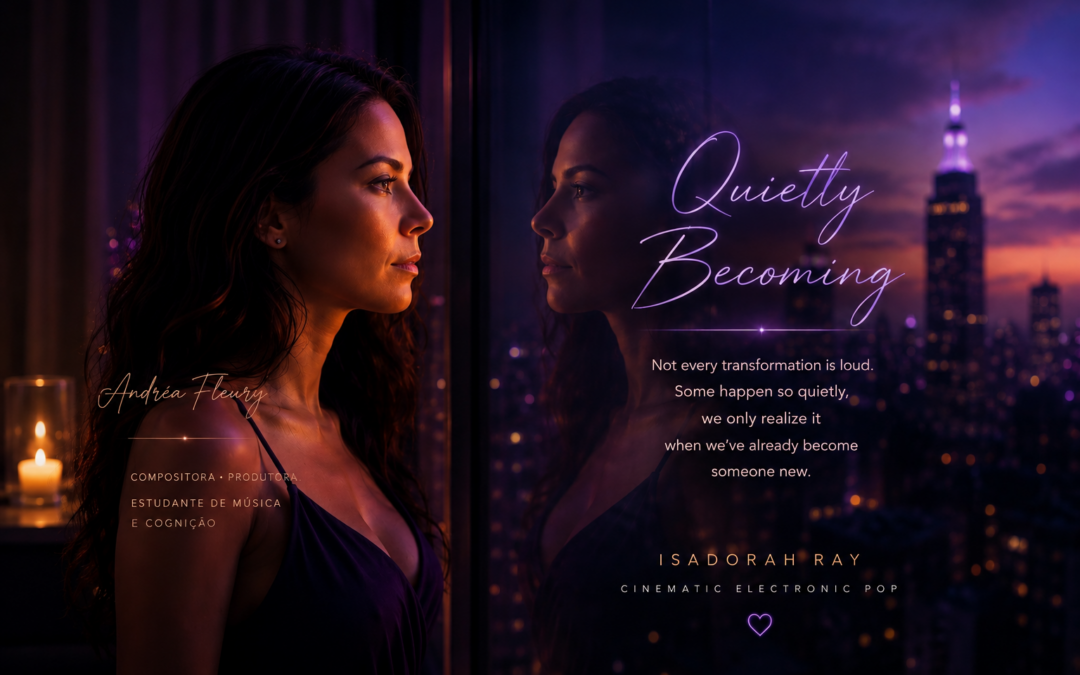
One of the questions I receive most often is why Isadorah Ray sings the way she does.
The answer begins long before the microphone.
As a songwriter and a student of Music and Cognition, I’ve become increasingly fascinated by something that often goes unnoticed:
music doesn’t need every element competing for attention.
In fact, quite the opposite.
The most moving performances happen when every instrument has the space to speak.
That idea became one of the foundations of Isadorah Ray.
Instead of placing the voice above everything else, I wanted it to become part of the musical conversation.
In Quietly Becoming, the piano creates space.
The strings carry the emotional weight.
The violin expresses what words sometimes cannot.
And Ray…
Ray doesn’t interrupt that conversation.
She joins it.
Her voice doesn’t compete with the arrangement.
It listens.
It responds.
It leaves room for silence whenever silence can say more than another note.
People sometimes mistake restraint for simplicity.
To me, it’s the opposite.
The more I study music, the more I realize that emotion doesn’t come from singing louder or adding more.
It comes from intention.
From understanding what the song truly needs.
Sometimes that means allowing the arrangement to breathe.
Sometimes it means trusting a pause.
Sometimes it means letting the violin finish the sentence instead of the voice.
That is the philosophy behind Quietly Becoming.
The arrangement carries the emotion.
The voice carries the perception.
And somewhere between the piano, the violin, and the silence…
something quietly becomes part of us.
💜
A very subtle, intelligent and deeply emotional piece. It quietly becomes exactly what it needs to be.
The chorus moved me in a way I honestly didn’t expect. It doesn’t arrive loudly or dramatically it simply opens something inside me. I wasn’t really prepared for how gently it would touch me.
Thank you so much, KoWaLuS.
Reading your comment genuinely made me smile because you described exactly what I hoped *Quietly Becoming* would become.
I never wanted the chorus to arrive by demanding attention. I wanted it to grow naturally, almost unnoticed, until it simply felt… inevitable.
The fact that you experienced it that way tells me the music found exactly the space it was meant to.
Perhaps that’s the greatest compliment a songwriter can receive: knowing the song quietly became exactly what it was meant to be.
Thank you for listening so deeply—and for always hearing the details behind the notes. It truly means a lot to me.