
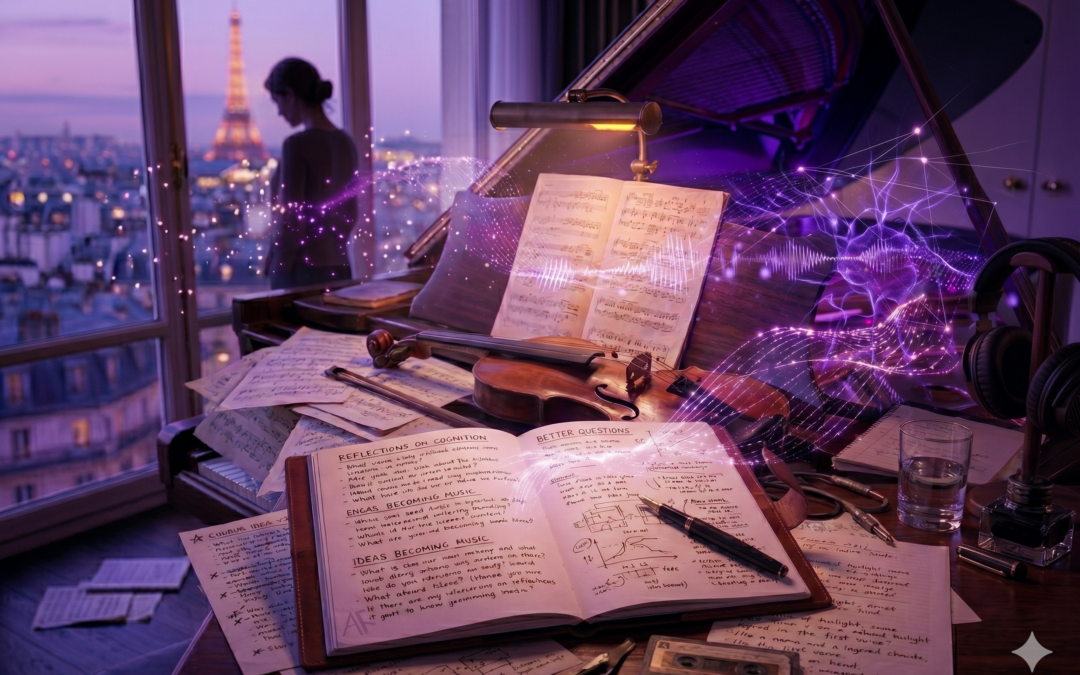
Better Questions: Where Music, Technology and Perspective Meet
Some songs begin with a melody.
Others begin with a question.
Better Questions started long before the first note was written.
It grew out of an idea that has stayed with me for quite some time: the realization that some people don’t enter our lives to give us answers. Instead, they expand the way we see the world. They shift our perspective. And in doing so, they leave us with questions that are more valuable than the answers we thought we were looking for.
That idea became the foundation of the lyrics.
But the lyrics were only one part of the journey.
Over the past few years, my studies and creative work have increasingly focused on the intersection of music, cognition, artificial intelligence, creativity and human behavior. As a researcher, I am fascinated by how we create meaning. As a songwriter, I am interested in transforming those reflections into emotional experiences.
Better Questions emerged from that intersection.
The song began at the piano, where I often explore harmonic structures, emotional movement and melodic ideas. Many of the earliest sketches emerged there, searching for a feeling of discovery, reflection and quiet transformation.
From that foundation, the production process evolved with the support of artificial intelligence tools. Rather than replacing human creativity, these tools became part of the creative environment itself. The artistic direction, lyrics, emotional intent, arrangement decisions and overall vision remained deeply human.
Technology helped build the path.
The destination was still guided by meaning.
Another essential part of the process was the development of Isadorah Ray’s voice.
Although Ray exists as a digital artist, her vocal identity was developed from my own artistic sensibilities. Her delivery reflects qualities I recognize in myself: emotional restraint, intimacy, subtlety and a preference for suggestion rather than explanation. A voice designed to create connection without sacrificing mystery.
Yet for nearly two months, the song remained unfinished.
Something was missing.
The melody was there.
The lyrics were there.
The production was there.
But the song had not yet found its final form.
The missing piece turned out to be the violin.
More than an accompanying instrument, it became a second voice within the narrative. In many moments, the violin answers the vocal line, extends emotions beyond words and creates spaces that language alone cannot reach.
That was the moment everything came together.
The final version of Better Questions emerged from the interaction of multiple creative layers: songwriting, piano, arrangement, storytelling, technology, experimentation and research.
Perhaps that is why this song represents such an important moment in my creative journey.
A moment when science and art no longer occupy separate spaces.
A moment when technology and humanity coexist within the same creative process.
And above all, a reminder that some of life’s most meaningful discoveries begin not with better answers, but with better questions.
💜
Andréa Fleury
Ainda Somos Humanos?
Many of the ideas explored in Better Questions also appear throughout my book Ainda Somos Humanos?, where I examine artificial intelligence, technology, perception, decision-making and the qualities that continue to define the human experience in an increasingly connected world.
The professional way you describe the creation of the track deserves the highest recognition.
Thank you, KoWaLuS.
I’ve always been fascinated by what happens before a song becomes a song. Sometimes the process reveals as much as the music itself. I’m happy that part resonated with you as well. ✨