
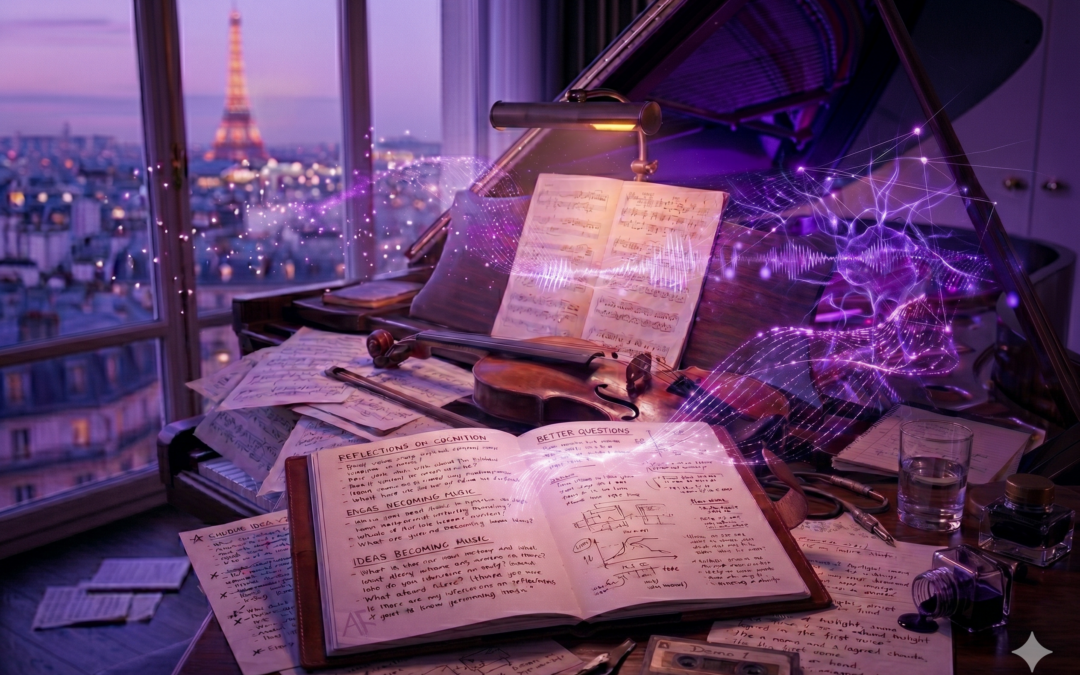
When we listen to a song, we hear the finished result.
What we rarely hear is everything that happened before that final version existed.
Better Questions spent almost two months in that unfinished space.
The lyrics were written.
The melody was written.
The emotional direction was clear.
And yet, something was still missing.
For me, songwriting is rarely a linear process. Songs emerge through layers, revisions, experimentation and unexpected discoveries. Sometimes they arrive quickly. Sometimes they take weeks to reveal what they are truly trying to become.
In the case of Better Questions, the process began at the piano.
Most of my songs do.
The piano is where I explore harmonic movement, emotional pacing and melodic ideas. It is often where the emotional architecture of a composition first appears.
From there, the arrangement gradually expanded.
The lead vocal became the narrative voice.
Backing vocals added texture, depth and subtle emotional reinforcement.
The piano and keyboards established the harmonic foundation.
Strings helped shape the cinematic atmosphere that became central to the song’s identity.
Bass and drums introduced movement while preserving space and restraint.
Subtle synth layers added dimension and helped connect the organic and electronic elements of the production.
Each layer had a purpose.
Each layer contributed something meaningful.
And still, the song felt incomplete.
The answer arrived through the violin.
What began as an additional instrument quickly evolved into something far more important.
A second voice.
Rather than simply accompanying the vocal, the violin began responding to it. Sometimes it completed a thought. Sometimes it extended an emotion. Sometimes it expressed what words could not.
Gradually, it became part of the conversation itself.
That was the turning point.
The moment when the song finally became what it was meant to be.
One of the aspects I find most fascinating about contemporary music creation is the ability to combine traditional composition with new creative tools.
Like many of my recent projects, Better Questions was developed with the support of artificial intelligence throughout different stages of the process. Yet every artistic decision remained human: the concept, the lyrics, the emotional direction, the arrangement choices and the final vision.
Technology expanded possibilities.
Meaning came from intention.
Another unique aspect of the process was the creation of Isadorah Ray’s vocal identity.
Although Ray exists as a digital artist, her voice was developed from my own artistic references and vocal sensibilities. Because of that, creating harmonies, backing vocals and additional vocal layers feels remarkably natural. In many ways, I already understand how the voice should respond emotionally because it originates from the same creative instincts.
Looking back, Better Questions became much more than a song.
It became a meeting point between songwriting, piano, arrangement, storytelling, technology, experimentation and research.
And perhaps that is why the title feels so appropriate.
Some discoveries arrive as answers.
The most meaningful ones often arrive as better questions.
💜
Andréa Fleury
Ainda Somos Humanos?
Many of the ideas explored in Better Questions also appear throughout my book Ainda Somos Humanos?, where I examine artificial intelligence, technology, perception, decision-making and the qualities that continue to define the human experience in an increasingly connected world.