
By Andréa Castro Fleury
When we talk about artificial intelligence, we usually think about logic, computation, and data.
But something much deeper is happening beneath the systems we are building:
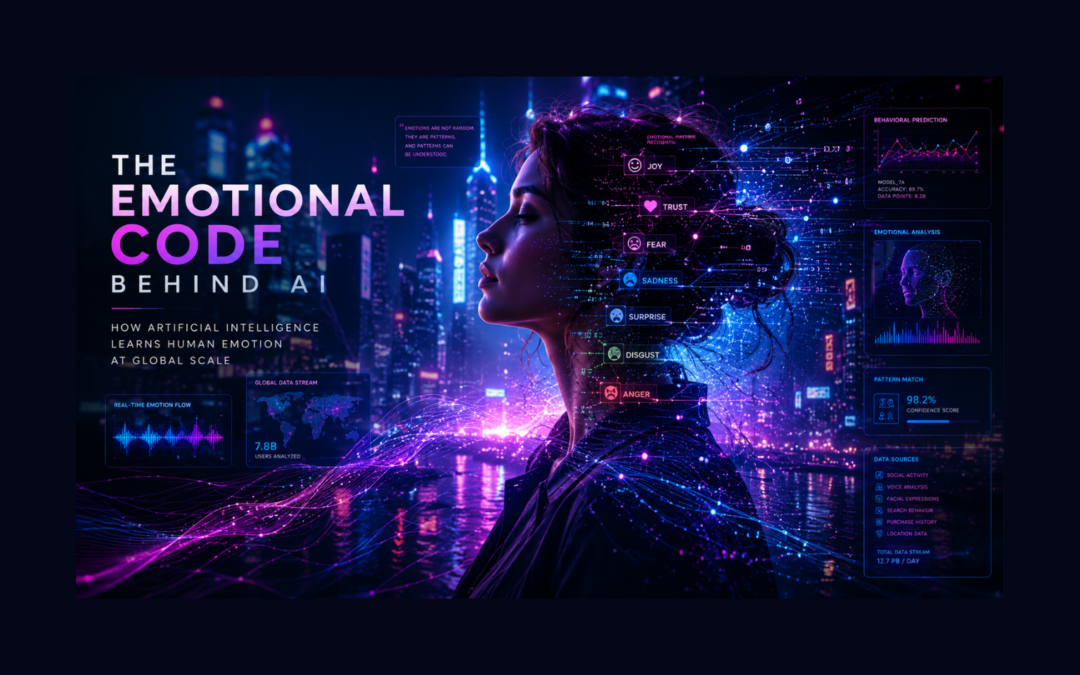
AI is learning human emotion at a global scale.
Not because machines “feel” the way humans do.
But because billions of people continuously feed these systems with emotional patterns.
Anger.
Desire.
Loneliness.
Fear.
Hope.
The need for belonging.
All of it leaves digital traces.
And perhaps this is exactly where the conversation about AI becomes truly fascinating — and dangerous.
Because the real power is not merely creating intelligent responses. The real power lies in the ability to predict human behavior.
Today, platforms can identify:
- what captures our attention
- what triggers anxiety
- what drives consumption
- what keeps us engaged
- what emotionally affects us
Human emotion has become a data architecture.
And this completely changes the relationship between technology and society. Systems capable of understanding emotional patterns can influence decisions in incredibly subtle ways.
Not through explicit control.
But through optimization.
The perfect feed.
The perfect narrative.
The perfect stimulus.
And perhaps the most curious part is this:
we ourselves are training these systems to understand who we are.
That is why I believe the future of AI will not be merely technical. It will be psychological, philosophical, and profoundly human.
The next revolution is not only computational intelligence.
It is emotional understanding at scale.
And perhaps the greatest mirror humanity has ever built is not a physical object — but a system capable of reflecting our own desires, fears, and contradictions back to us.
The question is:
When that mirror becomes complete… will we be ready to face what it reveals?