
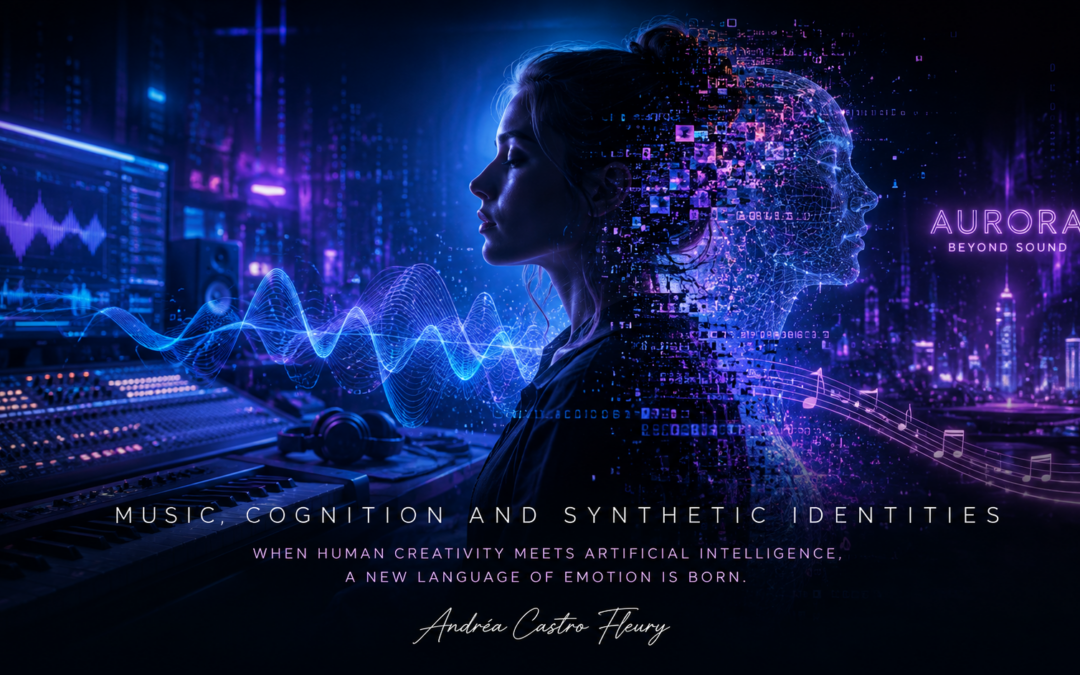
By Andréa Castro Fleury
Música, Cognição e Identidades Sintéticas
Music has always been one of the deepest forms of human experience.
It moves through memory, emotion, language, identity, and perception all at once. A song can transport someone back to another moment of life within seconds. It can alter emotional states. It can create belonging.
Now imagine what happens when artificial intelligence enters that territory.
We are beginning to live through a new creative era: the era of synthetic identities.
Digital artists.
Artificial voices.
AI-generated personas.
Hybrid experiences between human and machine.
Many people approach this with fear. I also see it as a fascinating field of artistic and cognitive exploration.
Because perhaps the most important question is not “Who is singing?”
But rather: “What does the music awaken in the listener?”
If a song creates emotion, connection, memory, and meaning… does it become less real simply because AI participated in its creation?
That question completely reshapes the concept of authorship.
Today, digital artists can exist as emotional extensions of their creators. Not as replacements for humans — but as new narrative languages.
AI does not eliminate art. It changes the interface of creation.
And perhaps that is exactly why music and artificial intelligence connect so deeply with human cognition: both operate through patterns.
Music organizes emotion through frequency and time.
AI organizes information through probability and structure.
When those two systems meet, something entirely new emerges:
a hybrid aesthetic between human emotion and digital architecture.
I do not believe synthetic identities will replace human artists.
I believe they expand creative possibilities.
Because in the end, there is still someone behind the machine:
someone choosing feelings, atmospheres, words, silences, and meaning.
Technology can generate sound.
But artistic intention still comes from human experience.