
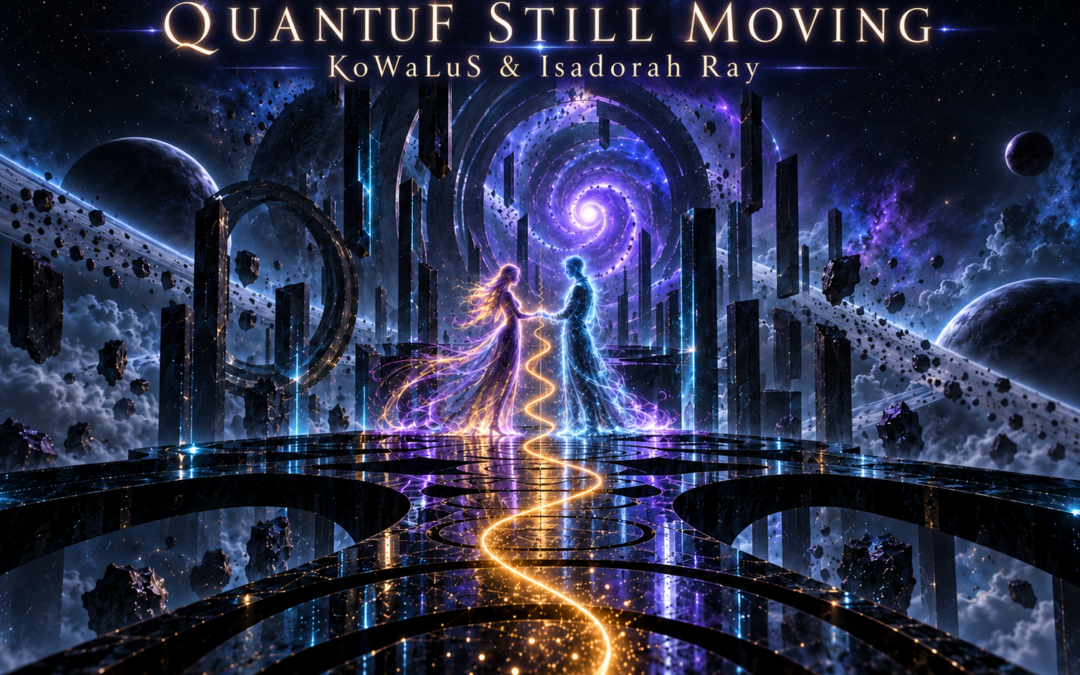
QuantuF Still Moving: Between Memory and the Future
QuantuF Still Moving is not a bonus track in the usual sense. It does not conclude Finding Isadorah Ray, nor does it claim a twenty-third door. It exists alongside the twenty-two: as the record of a journey that did not end when it appeared to have reached its destination.
The song emerges from the meeting of two distinct worlds. On one side, the vocal intimacy of Isadorah Ray; on the other, the conceptual and experimental density of KoWaLuS. Yet the track does not turn that difference into a contest. Voice, violin and electronic texture listen to one another. The violin is not an ornament: it becomes a second presence — an answer, a shadow and, at times, what the lyrics choose not to say.
There is movement throughout the track, but not the movement of escape. It is the feeling of someone who has crossed something, been changed by it, and continues on. The song holds an unusual space between melancholy and continuity: it acknowledges what has been left behind without allowing itself to be imprisoned by it.
The production preserves the song’s breathing space. Rather than relying on abrupt contrasts or excessive polish, it sustains a continuous emotional tension in which voice, violin and electronic texture coexist without competing for attention. Presence and delicacy inhabit the same gesture: the track remains intimate, organic and alive.
The Temporal Paradox of QuantuF — by KoWaLuS
There is another hidden paradox within the track: a strange melancholy that seems to belong not to the past, but to a time that has not yet happened.
Around 0:39, this feeling becomes especially vivid. It is almost as though the woman in the song is remembering something from the future — something she has already lived somewhere beyond our present — before finding her way back to what she once left behind.
Perhaps this is where QuantuF Still Moving reveals its deepest connection to the QuantuF universe. Its nostalgia does not point towards the past in the conventional sense. It creates a longing for a place we have never been, for memories we cannot yet have. The track seems to exist between two directions of time: remembering what was lost while, somehow, anticipating what is still to come.
That is why it becomes so difficult to leave after the music ends. It does not feel entirely like a memory or a prediction. It feels like a place that already exists somewhere ahead of us, waiting for us to arrive.
In the end, the title says exactly what the track does: it keeps moving — and takes us with it, not back to where we were, but to a point somewhere between memory, presence and possibility.
Andréa Castro Fleury (Isadorah Ray) & Piotr Paweł Kowalski (KoWaLuS)