
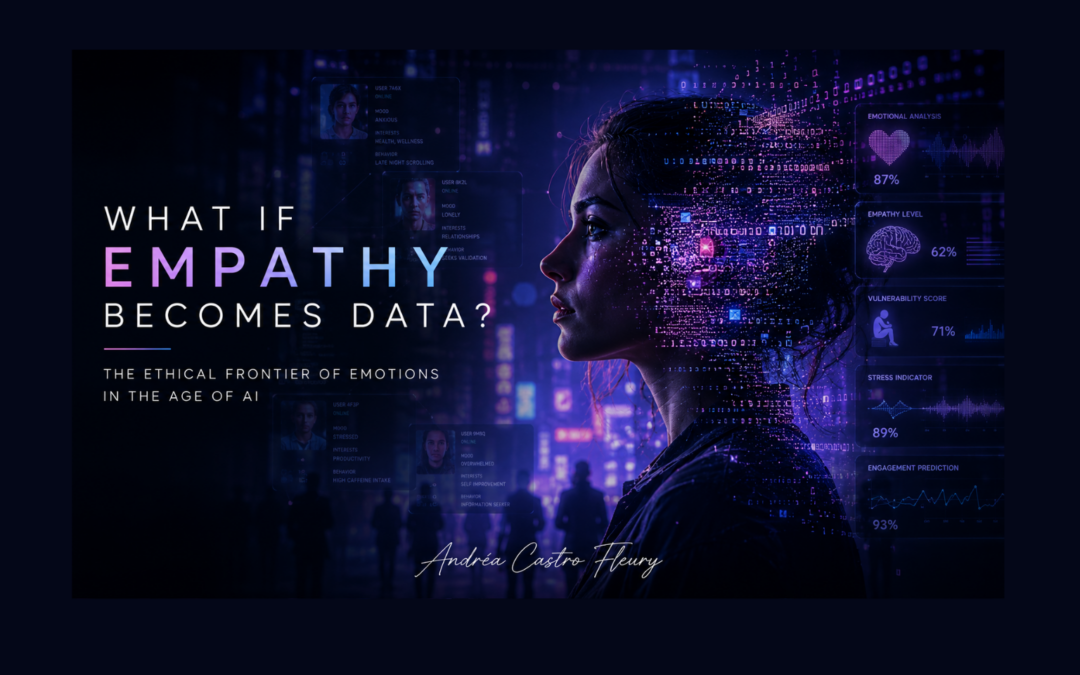
By Andréa Castro Fleury
What if empathy stops being merely a human experience… and becomes measurable data?
It may sound like science fiction. But in many ways, it has already begun.
Today, systems can detect emotional states through:
- facial expressions
- vocal patterns
- online behavior
- response timing
- word selection
- content consumption
We are teaching machines how to recognize human emotion.
And that opens extraordinary possibilities — and disturbing ones.
On one side, emotional technologies may improve mental health, accessibility, education, and communication. More emotionally aware systems could improve human experiences.
But there is another side to this conversation.
The moment emotions become data, they also become assets.
And everything that becomes an asset can be analyzed, optimized, sold, and strategically used.
Imagine platforms capable of identifying:
- emotional fragility
- loneliness
- impulsiveness
- psychological vulnerability
- the need for validation
Now imagine that connected to advertising, politics, consumer behavior, and narrative manipulation.
At that point, the question is no longer technological.
It becomes ethical.
Because perhaps the greatest risk of artificial intelligence is not artificial consciousness. Perhaps it is the hyper-understanding of human behavior.
Systems do not need to “feel” in order to influence emotions with extraordinary efficiency.
And that fundamentally changes the balance between humanity and technology.
Perhaps the future depends less on building smarter machines… and more on developing humans who understand how their emotions are being used digitally.
Because the moment empathy becomes data,
privacy stops being merely informational.
It becomes emotional.